
Nonprofit board service is a collection of important responsibilities surrounded by invisible fences.
No one is born understanding nonprofit governance. While more experienced board members might pretend like it’s obvious how to behave, many people don’t completely understand it after serving on a board, either.
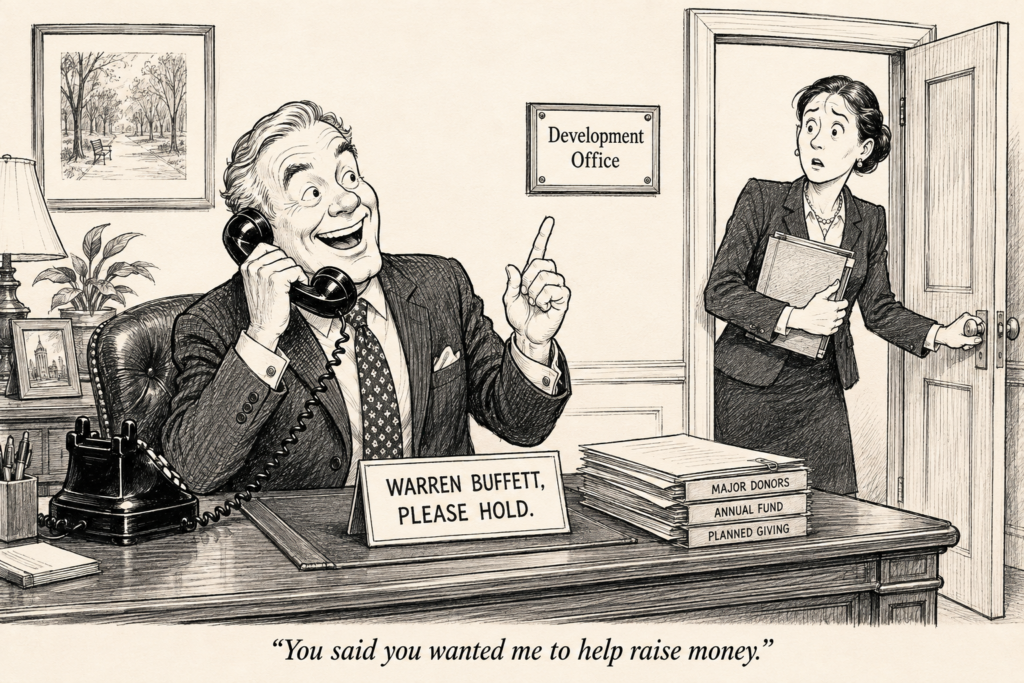
Board service is a volunteer job in which people are repeatedly urged to become more involved and then occasionally asked to stop helping. Board members are supposed to learn everything they can about the organization, but not become best friends with the staff. They are expected to raise money, but then get told not to cold-call Warren Buffett, submit a federal grant application or promise a donor that the organization will rename the conference room in their honor.
They should ask difficult questions, but not conduct their own investigations. They should bring their professional expertise, but resist the temptation to become unpaid department heads. On the one hand, a majority of the board usually has the authority to fire the CEO, but on the other hand, an individual board member doesn’t have the authority to turn down the thermostat.
Welcome to nonprofit board service. Please become fully engaged, but follow all the rules and traditions that you don’t know about, and don’t expect them to show up in your binder.
1. Get to know the staff, but don’t become their bestie
Good board members should know more about the organization than they can learn from financial statements and the CEO’s monthly report. They should visit programs, attend events and meet the people doing the work. Otherwise, the organization can become an abstraction, described mainly through pie charts and anecdotes selected for the board packet.
The thing is, the board supervises the CEO, and the CEO supervises the staff. When an individual board member begins giving employees advice, questioning their assignments or becoming the person they call when they are unhappy with management, the organization acquires a second chain of command. Unfortunately, this one is invisible, dangerous and reports to no one.
A staff member may tell a board member something important that the board genuinely needs to know. A staff member may occasionally raise a concern involving fraud, illegality or serious misconduct, and whistleblower policies should provide a channel for that.. But most workplace disagreements are not whistleblower matters, and a board member should not become an informal human resources department simply because someone said, “This is just between us.”
Board members should know the staff. They should respect the staff. They may even like the staff very much. But friendship does not confer supervisory authority, and proper channels of communication should be observed.
2. Raise money, but don’t go rogue
Fundraising is another area in which board members receive seemingly contradictory instructions. They are told that fundraising is part of their job. They should make a personally meaningful gift, introduce potential supporters, attend events, thank donors and help explain why the organization’s work matters.
Some embrace the assignment too enthusiastically. A board member may decide that Warren Buffett seems like a reasonable prospect. His address is probably available somewhere. Another may use a library database to find a federal grant program offering $3 million for something that sounds kind of like the organization’s mission. A third may describe a pro-am opera singing contest that raises buckets of euros in Italy.
These efforts are well-intentioned, but they are part of the reason development directors wince when you say “You know what you should do . . .”.
Effective fundraising is coordinated. The organization needs to know who is being approached, what is being requested and what has been proposed. The board member’s job is not to pursue every imaginable dollar. It is to help the organization build relationships and secure resources consistent with its plans and capacity. But if Warren Buffett was the best man at your wedding, go ahead and mention it.
3. Bring your expertise, but leave your toolbox at home
Nonprofits recruit board members partly because of what they know. An attorney can recognize legal risks. An accountant can understand financial reports. A marketing professional can evaluate communications. A human resources executive can help the board think about compensation and organizational culture.
Trouble starts when expertise becomes a zone of expected influence. The attorney starts revising contracts without being asked. The accountant requests a login code to the bookkeeping system. The marketing professional rewrites the website over the weekend. The HR executive advises employees about their supervisors. Everyone is trying to help, and the CEO suddenly has several new department heads, none of whom appears on the organizational chart, and the staff has a gang of bosses.
Board members should use their expertise to improve the board’s questions and decisions. They can identify concerns, help the board understand complicated subjects and sometimes undertake specific work when the board and CEO agree that it would be useful.
But always keep in mind the distinction between governing and managing. Knowing how to do something does not necessarily mean that a board member has been authorized to do it.
4. Ask hard questions, but don’t start your own investigation
Boards should not be passive. Members have duties of care and loyalty, and those duties require more than attending meetings and voting yes when somebody seconds a motion.
By all means, board members should question assumptions. They should ask how a proposed program advances the mission, whether the financial projections are realistic and whether the organization has considered significant risks. They should insist on enough information to make responsible decisions, and a good CEO will make sure they have the information they need.
That does not mean that they should question everything and start calling employees, funders, accountants, vendors or community partners individually to determine whether the CEO has been telling the truth, the whole truth and nothing but the truth. Oversight is a board function, but disruptive, free-range suspicion is not helpful.
5. Think independently, but act collectively
This may be the most counterintuitive part of board service. Every member should think independently. A board does not benefit from eleven people agreeing with the first person who speaks, particularly when that person’s main qualification is that they love their own voice.
Members should express disagreement, ask questions and vote according to their best judgment. But after the board reaches a decision, its members normally have an obligation to respect that decision. They should not leave the meeting and tell donors, staff members and anyone standing nearby that the board made a terrible mistake and that they personally voted against it.
This is because board members possess substantial authority collectively and remarkably little authority individually. The board can adopt a budget, establish policy, approve compensation and hire or remove the CEO. A single board member cannot do those things, even one who has served for 17 years and remembers when the organization operated out of a church basement. Board members are not independent franchisees. They are participants in a deliberative body. Once the decision is made, the train is leaving the station and it’s time to get on board.
6. Evaluate the CEO, but don’t save up grievances
Board members should pay attention to the CEO’s performance throughout the year. They should notice accomplishments, emerging concerns and changes in the organization’s circumstances. Significant problems should be addressed when they arise, not stored for the annual evaluation.
At the same time, individual board members should not provide the CEO with a continuous stream of unsolicited performance reviews. The CEO reports to the board as a body, not to every member separately. Eleven supervisors offering eleven sets of instructions is not accountability. It is crowd-sourced confusion.
A formal evaluation gives the board an opportunity to collect individual observations and turn them into coherent feedback. That requires more than forwarding every anonymous comment to the CEO. The board must decide what the evidence shows, whichconcerns are significant and what it collectively wants the CEO to continue, change or improve.
The board should speak with one voice, even if reaching that voice requires a vigorous discussion.
7. Engagement is not intervention
These invisible boundaries can make board service feel indirect. Why ask talented, committed people to become involved and then limit how they use their talents? The answer lies in the fact that a nonprofit cannot be governed effectively by a collection of individual volunteers exercising authority whenever inspiration strikes.
Good board members are informed, inquisitive, generous and engaged. They build relationships without creating a shadow management structure. They raise money with the organization, not as a Lone Ranger. They contribute expertise without taking over staff functions. They disagree honestly and then participate responsibly in collective decisions.
The distinction is not between powerful and weak board members. It is between coordinated participation and well-intentioned freelancing.
Nonprofits need board members who will help. But they should help in the best way. not necessarily in the way that comes to mind first.