
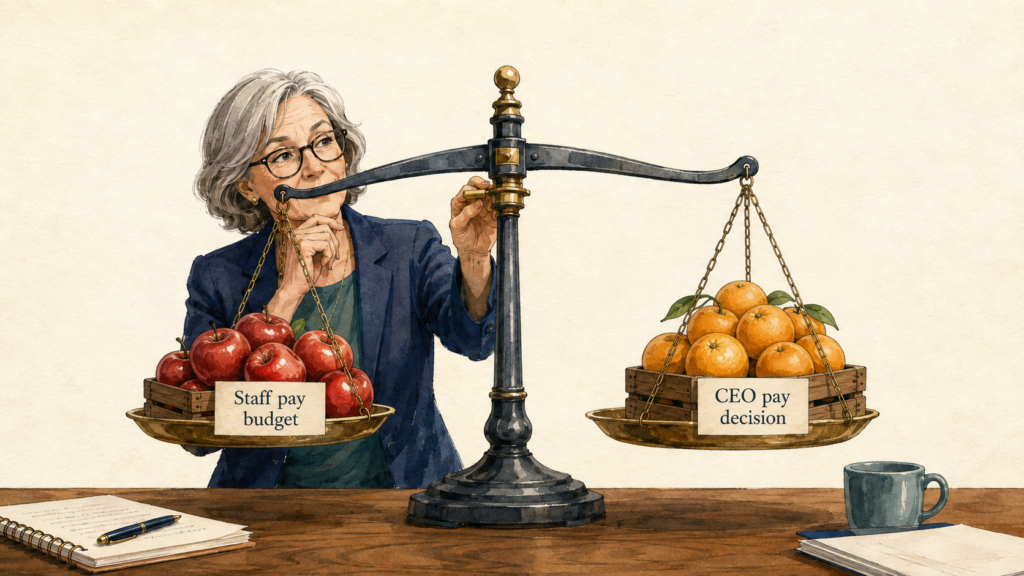
When a board is approving the budget of a nonprofit, it usually sees a number that represents a percentage increase for employee salaries. It is natural to ask whether the CEO should receive the same percentage.
I certainly understand the temptation. It feels evenhanded. It’s easy to explain. It avoids the awkward optics of staff receiving modest raises while the CEO gets something bigger. And, let’s face it, it gives a board a tidy answer to a question that can otherwise require research, discussion, and judgment.
“We approved a 3% increase for employees, so the CEO will receive 3% too.”
The thing is, the same percentage might be the right decision. But it should be the result of a thoughtful CEO compensation review, not a substitute for one.
Why the same percentage is appealing
Nonprofit work depends on trust. Staff members want to know that their board and CEO understand the realities of their lives. A common percentage increase can reinforce the idea that everyone is rowing in the same direction, particularly after a difficult year or during a period of tight budgets. It also prevents a board approving a large CEO raise in the same year that employees receive very little, or nothing at all.
Those concerns are legitimate. Boards should take them seriously.
And there are times when the simplest answer is entirely sensible. If the CEO’s pay is already well supported by comparable data compiled in the past year or two, the CEO has performed well, and the organization is providing a general cost-of-living or merit adjustment to staff, applying the same percentage to the CEO may be a sound and defensible decision.
I’m certainly not arguing that the CEO should always receive a different increase. The easy answer is not necessarily the wrong answer, but the easiness should not be the end of the inquiry.
Equal percentages do not always mean equal treatment
A percentage is not a neutral thing.
A 3% increase for an emp loyee earning $50,000 is $1,500. A 3% increase for a CEO earning $200,000 is $6,000. Both employees received the same percentage, but the dollars are very different, and the impact on each person’s household budget may be different as well. That $1500 might be urgently needed to keep up with a skimpy budget, while the $6,000 might be insignificant to the CEO’s household budget
That does not mean the CEO should receive a lesser increase. It does mean that “the same percentage” is not, by itself, much of a fairness analysis.
Nor does the percentage reveal whether either salary is appropriate in the first place.
A CEO may be underpaid relative to similar organizations and responsibilities. An organization may be struggling to retain a leader with unusually difficult responsibilities. The lower-paid employee might be doing the exact same work at the exact same pace year after year, while the CEO is expanding their responsibilities by adding new programs and growing the entire organization. Or perhaps the CEO is already paid at the high end of the relevant market, and their performance has been underwhelming over the past several years. The board cannot know whether a 3% increase is prudent merely because 3% happens to be the number selected for the broader staff budget.
The CEO’s pay is a separate board decision
The board is responsible for evaluating the CEO and setting their compensation at a reasonable level. That process should consider the CEO’s performance, the size and complexity of the organization, the relevant labor market, total compensation, and compensation paid by genuinely comparable organizations.
And, yes, it should also consider what is happening with staff pay. Staff pay is not irrelevant. A board does not set the CEO’s salary in a vacuum. It should understand whether the organization is making meaningful investments in staff compensation, whether employees are leaving for better-paying jobs, and whether the CEO’s recommendation for the staff budget is consistent with the organization’s stated values.
But staff increases and CEO compensation are related decisions, not identical ones.
The right CEO increase might be the same as the general staff increase. It might be smaller. It might be larger because of a documented market adjustment or substantial new responsibilities. Does the CEO have 10 years of experience, or have they had one year of experience 10 times?
A better board question
Instead of asking only, “Should the CEO get the same raise as everyone else?” a board might ask:
“What CEO compensation decision is appropriate this year, after considering performance, comparability, the organization’s financial position, and what we are asking of our staff?”
Sometimes that inquiry will lead to the same percentage. That is perfectly fine, as long as the board reached the decision after considering the CEO’s compensation independently, rather than using the staff increase as a convenient shortcut.