
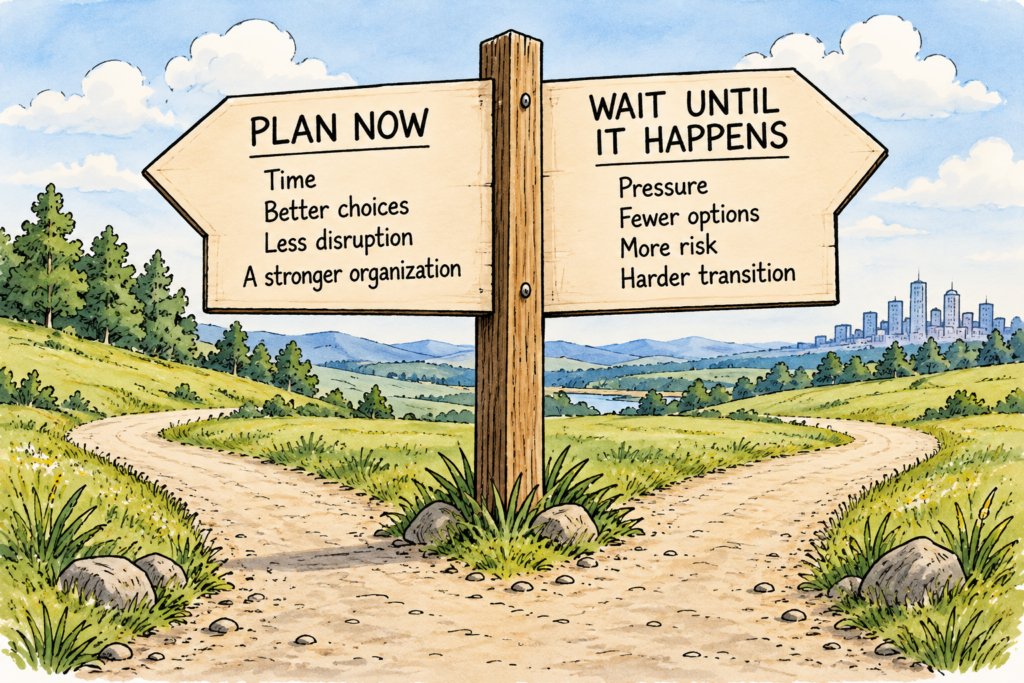
Transition at the top can be extremely challenging for any organization. I’ve seen organizations suffer through bloody transitions while others shift gracefully, retaining the strengths brought by the departing CEO and adding those of the newcomer. Two organizations announced on October 1 that their CEOs will be leaving, and both of them were unusual, in good ways.
Steve Radley, who has led Network Kansas since its beginning more than 21 years ago, announced that he will leave the organization at the end of March. His replacement has already been selected. Erik Pedersen, the organization’s president and COO, started there just two weeks after Radley did in 2005. The board and executive leadership had spent several years of intentional succession.
Also on October 1, Mindy Lubber announced that she will step down as president and CEO of Ceres, the sustainability nonprofit she has led for 23 years. Her departure isn’t scheduled for next spring. It isn’t even scheduled for next summer. She won’t be leaving until the end of 2027 – 15 months away. Ceres will conduct a national search. Ms. Lubber explained the unusually early announcement quite nicely: the organization deserved “a transition built on care, not urgency.”
There are two very different succession models here. Network Kansas developed an internal successor over a period of years. Ceres is giving its board more than a year to conduct a national search. What they have in common is that neither organization waited for a resignation letter to start thinking about what would happen next.
Hoping for a few more years is not a succession plan
Every nonprofit CEO is temporary.
Some serve for three years. Some serve for 23. Some retire. Some accept another job. Some get sick. Some get fired. Occasionally someone simply decides they are tired of the challenges of running a nonprofit, and they could make more money with fewer headaches elsewhere.
Eventually, every CEO leaves. Boards generally understand this. That doesn’t mean they prepare for it. BoardSource reports that only about 29 percent of nonprofit organizations have a written executive succession plan. That is remarkable when you consider how much organizational risk it represents. The CEO may hold the organization’s most important donor relationships, understand its government contracts, know why a particular employee arrangement exists, remember how the bank financing was negotiated and have the cell phone numbers of six people the organization absolutely needs when something goes wrong.
Then the board chairgets an email beginning, “After considerable reflection…”, and everyone starts wishing they had thought more about succession planning.
Succession planning isn’t picking the next CEO
One reason boards may avoid the subject is that “succession planning” sounds a little like secretly choosing someone’s replacement while they are still sitting in the room. I understand, because it seems a little rude, even though it shouldn’t. In fact, it’s a whole lot easier to start when things are going well than when things start to crumble. An appreciated, confident CEO should be a happy participant in the process. An embattled CEO on a bad luck streak is going to see it as bold font writing on the wall.
Good succession planning is really organizational planning.
It asks questions such as:
- If the CEO became unavailable tomorrow, who would have authority to keep the organization operating?
- What knowledge currently resides primarily with the CEO?
- Which relationships would be especially vulnerable during a transition?
- Is there enough leadership depth among the senior staff?
- What will the organization probably need from its next CEO that it did not necessarily need from the current one?
- Who makes decisions during an emergency transition?
- How would employees, donors, funders and other important stakeholders be told?
- What role should the departing CEO play in the transition, and where should that role end?
Those are worthwhile questions even if the CEO intends to remain for another ten years. The key is to do start early, not in the eleventh month of year 9. Better yet, review and update the plan annually, because things change, whether the board realizes it or not.
There are really two succession plans
Every nonprofit board should probably think about succession in two separate ways.
The first is emergency succession.
The CEO gets seriously ill on Thursday. Who has authority over what on Friday?
That plan can be surprisingly simple. Identify who temporarily assumes which responsibilities, who can sign checks and contracts, who communicates with employees and outside stakeholders, and when the board meets to determine what happens next.
This isn’t pessimism. Organizations carry insurance and maintain backups for the same reason. Important systems need redundancy.
The second is planned succession.
That is the Network Kansas or Ceres version. A long-serving executive knows a transition is approaching, and the board has time to think carefully about the organization’s next chapter.
That process should involve more than deciding where to advertise the job. A CEO transition is a perfect moment to ask a fundamental question: “What kind of organization are we becoming, and what kind of leader will that organization need?”
The answer will probably produce a job description quite different from the one written 15 years earlier. People and organizations change.
Long-serving CEOs create a special challenge
The better a CEO has been, the easier it can be for a board to become dependent on that person. That makes perfect sense. A good executive gradually accumulates knowledge, relationships and authority. Board members rotate on and off. The CEO becomes the institutional memory. Eventually the organization may have trouble distinguishing between the responsibilities of the position and the particular abilities of the person occupying it. The role of CEO develops a personality, and nobody can imagine anyone else being as good as the current CEO.
That is one reason a 20-year CEO can be much harder to replace than a five-year CEO. The answer isn’t to ignore the qualities of the long-serving executive. It is to use those years to strengthen the institution around them. Develop other leaders. Document important relationships and processes. Keep the board engaged enough to understand the organization independently of the CEO. Periodically review the CEO job description. Talk about where the organization is headed.
Succession planning should make an organization less dependent on any individual without making that individual less important. Appreciate the heck out of the great qualities of the CEO while thinking about how you can move forward with a different CEO with different qualities.
The departing CEO shouldn’t hire the next one
A strong CEO should be involved in preparing the organization for transition. They can help identify vulnerabilities, transfer relationships, develop staff, document institutional knowledge and give the board an unusually valuable perspective on the job.
But choosing the next CEO belongs to the board. The outgoing CEO should NOT be in charge of hiring the successor. It’s tempting to let the CEO play an outsized role in this decision. Nobody knows the shoes better than the CEO, so why not let them decide who can best fill them?
A long-serving CEO naturally has opinions about who should follow them. Sometimes an internal candidate is plainly excellent. Network Kansas appears to have spent years developing exactly that sort of transition. But the board still has to exercise independent judgment.
The next CEO is not being hired to preserve the outgoing CEO’s administration. The next CEO is being hired to lead the organization’s next one.
Start with one slightly uncomfortable conversation
Succession planning can begin with a conversation during a board meeting.
“What would we do if our CEO told us tonight that they were leaving tomorrow?” Depending on the personality of your board, you might ask “What happens if they get run over by a beer truck?”
See how far the board gets with the conversation. Who takes charge? Who speaks with staff? Is there an obvious interim leader? Who calls the organization’s largest funder? Where is the CEO’s current job description? Is the compensation level competitive enough to attract the person the organization would need? Who knows the passwords?
The gaps in the answers are the beginning of the succession plan.
The planning starts with the next question: “What should we be doing now so that this organization will be ready for its next leader whenever that day comes?”
Your CEO may give you 15 months’ notice, like Mindy Lubber. You may have several years to develop an internal successor, like Network Kansas. You may discover tomorrow morning that your CEO has accepted another job. Or you may have to make a change that nobody expected.
Unfortunately, you don’t get to choose your own adventure. What you can choose is whether your board is ready for it. Like Mindy Lubber suggests, your organization deserves a transition built on care, not urgency. The time to begin planning is while you still have that choice.
P.S. Succession planning is not a service offered by NPCEO Evaluation. If you’d like to get started and need some free resources, call or email me. If you’d prefer to hire a consultant, I can recommend some good people.
I’m keeping NPCEO focused on CEO evaluations and compensation reviews. That’s plenty. I don’t want to be the auto mechanic who insists you need new mud flaps and a headlight fluid flush.