
Responsible nonprofit boards pay attention to the compensation they provide their chief executives. The CEO is almost always the only employee for whom they are setting the salary. They must pay enough to attract and retain capable leadership while ensuring that the compensation is reasonable.
There can be serious consequences for getting this wrong. If the IRS determines that an executive received excessive compensation, the executive may be required to repay the excess, with interest, and pay an excise tax equal to 25 percent of it. If the transaction is not corrected within the required period, an additional tax equal to 200 percent of the uncorrected amount may be imposed. Board members who knowingly and willfully approved the arrangement, without reasonable cause, may also face a tax of 10 percent of the excess benefit, up to $20,000 for each transaction.
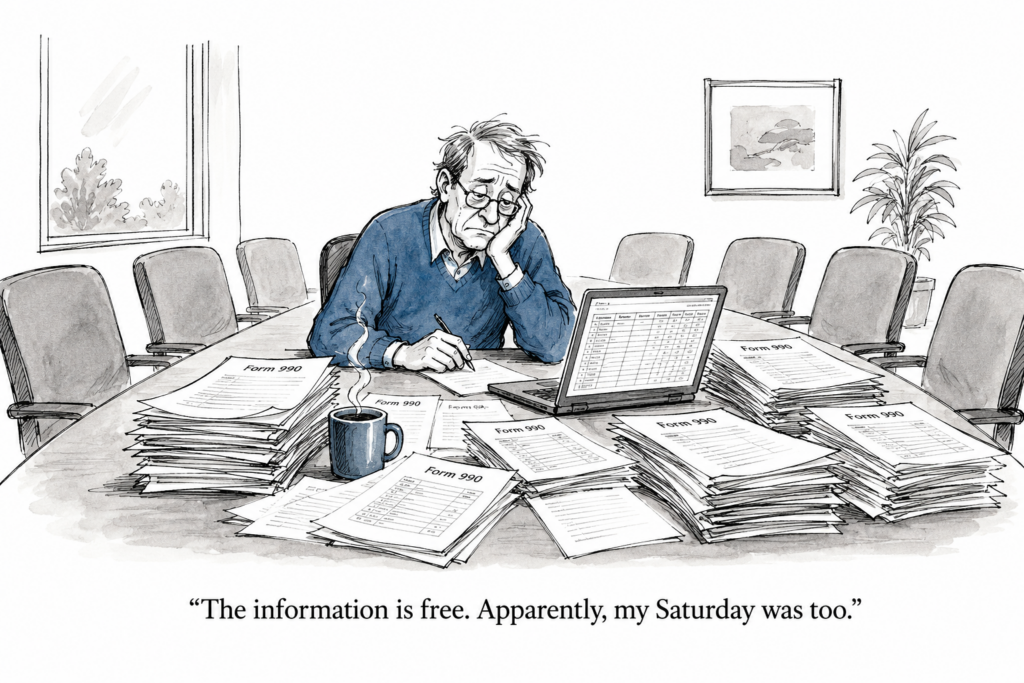
Fortunately, a board does not necessarily need an expensive national survey or a major consulting engagement to make a responsible and defensible decision. Much of the information it needs is publicly available, primarily through other nonprofit organizations’ Form 990 filings.
 With some time, a spreadsheet and careful judgment, a board can conduct a useful CEO salary study at little or no cost. There is an important qualification, however. Finding compensation figures is relatively easy. Choosing genuinely comparable organizations and interpreting those figures correctly is the harder part.
A salary study should not be a search for organizations that pay the number someone already wants to pay. The real work is deciding which organizations are genuinely comparable, and documenting why.
1. Begin with the position, not the person
Before looking at salaries, describe the job being evaluated. Titles are not particularly reliable. “Executive director,” “president” and “chief executive officer” may describe essentially the same position, or three very different positions.
Consider the responsibilities associated with the job:
- Annual organizational budget
- Number of employees
- Number of locations
- Complexity of programs and services
- Fundraising expectations
- Government contracts
- Regulatory responsibilities
- Management of buildings and other substantial assets
- Relationships with affiliated or related organizations
- Responsibility for a capital campaign
- Public visibility and community leadership
A CEO overseeing a heavily regulated health center with several locations and hundreds of employees has a different job from the CEO of a grantmaking foundation with the same annual revenue and a staff of six.
Revenue matters, but it is not a complete measure of executive responsibility.
2. Identify comparable organizations
A useful study generally includes organizations that resemble yours in several meaningful ways. Possible criteria include:
- Mission or type of service
- Annual revenue and expenses
- Number of employees
- Geographic labor market
- Organizational complexity
- Number of facilities or service locations
- Sources of revenue
- Regulatory environment
- Scope of the CEO’s responsibilities
Perfect comparisons rarely exist. The objective is to assemble a defensible group of organizations that are similar enough to provide useful information.
Avoid choosing comparison organizations based entirely on reputation or geography. The local children’s hospital is probably not an appropriate comparison for a neighborhood clinic providing flu shots. Conversely, an organization in another state may be highly comparable if it provides similar services, operates on a similar scale and competes in a reasonably similar labor market.
A larger group of credible comparisons is generally better than a very small group. It reduces the effect of an unusual salary or an organization whose circumstances you do not fully understand.
3. Find the organizations’ Form 990s
Several free resources make nonprofit tax filings publicly available.
ProPublica’s Nonprofit Explorer is usually the easiest place to begin. It allows you to search millions of filings by organization name, location, executive name or keyword. Organization profiles include financial summaries, executive compensation information and links to complete Form 990 filings.
The IRS also provides filings through its Tax Exempt Organization Search.
Candid, formerly GuideStar, maintains profiles of tax-exempt organizations. Some information is available through a free account, while its more advanced search and comparison tools require a subscription. Some libraries, community foundations and nonprofit resource centers provide access to Candid’s paid services.
You may also find Form 990s on an organization’s own website. Many nonprofits publish them in sections labeled “Financials,” “Accountability” or “Annual Reports.”
4. Know where to look on the return
On the standard Form 990, executive compensation is reported primarily in Part VII, Section A.
This section may contain three compensation figures:
- Reportable compensation from the filing organization
- Reportable compensation from related organizations
- Estimated other compensation from the organization and related organizations
For a total-compensation comparison, add all three columns.
Some organizations also complete Schedule J, which can provide additional information about compensation practices and individual compensation packages. The IRS offers an explanation of compensation reporting in Part VII and Schedule J.
Do not assume that the first salary figure shown represents the executive’s entire compensation. Retirement contributions, deferred compensation, health benefits and compensation from a related organization can make a substantial difference.
Also confirm that you have identified the correct person. An organization might use “president,” “executive director,” “administrator” or another title rather than “CEO.” In some organizations, a medical director, investment officer or other specialist may earn more than the chief executive.
5. Pay attention to the compensation year
This is one of the easiest places to make a mistake.
The most recently posted Form 990 may contain compensation information that is already two or three years old. Tax filings are not real-time salary reports.
There is another complication. For organizations operating on a calendar year, the compensation and financial reporting periods align. For organizations using a different fiscal year, however, compensation in Part VII and Schedule J generally covers the calendar year ending within that fiscal year, while revenue and expenses cover the organization’s fiscal year. The periods therefore overlap but do not match exactly.
Record the compensation year for every comparison. Use figures from approximately the same period whenever possible, and state clearly if the information is dated.
If your data covers several years, you may want to adjust older compensation figures for inflation. The Bureau of Labor Statistics CPI Inflation Calculator provides a simple way to do that.
6. Build a spreadsheet
A basic spreadsheet might contain the following columns:
| Organization | Location | Service type | Revenue | Expenses | Employees | Compensation from organization | Related-organization compensation | Other compensation | Total compensation | Compensation year |
|---|
Include a “Notes” column for important differences, such as:
- Multiple service locations
- Substantial health care or regulatory responsibilities
- Large capital campaign
- Significant endowment
- Management of affiliated organizations
- Interim CEO
- Partial-year compensation
- CEO transition during the year
These details help prevent an apparently precise number from producing a misleading comparison.
7. Look at the median, not just the average
Calculate both the average and median, but pay particular attention to the median.
The average can be pulled upward by one or two unusually highly paid executives. The median is the middle figure after all compensation amounts have been placed in order, so it is less affected by extreme results. Neither figure automatically restricts the board. They are reference points. Someone will always be at the top and bottom of any comparison group, and a board may have sound reasons for paying above or below the reported range.
A salary above the median is not necessarily excessive, and one below the median is not necessarily prudent. The board should also consider the CEO’s responsibilities, experience, performance, tenure and value to the organization. It should consider whether the existing compensation creates a meaningful risk of losing an effective leader.
8. Compare the entire compensation package
A study based only on salary can be misleading.
One organization may pay a higher salary but offer modest retirement benefits. Another may report a lower salary while making substantial retirement contributions or providing deferred compensation.
Where the information is available, consider:
- Base salary
- Bonuses and incentive compensation
- Retirement contributions
- Deferred compensation
- Health and insurance benefits
- Housing or automobile allowances
- Compensation from related organizations
- Other significant benefits
Form 990 data will not always reveal the complete value of every benefit. That is one of the limitations the board should acknowledge.
9. Consider purchasing a salary guide
A published nonprofit salary guide or compensation survey offers another option. These publications may provide more current information than Form 990s and may organize results by budget, geography, position and type of organization. They are often based on self-reported data on a survey – not on a Form 990 signed and submitted to the IRS.
Before buying a guide, find out:
- When the data was collected
- How many organizations participated
- Whether the survey includes organizations comparable to yours
- Whether results can be filtered by size, location and nonprofit subsector
- Whether the figures represent base salary, cash compensation or total compensation
- Whether the filtered sample is large enough to be meaningful
A national salary guide can provide useful context, but it may not answer the board’s central question: What are organizations like ours paying executives who are doing jobs like this one?
Salary guides and Form 990 research have almost opposite weaknesses. Form 990s provide detailed information about identifiable organizations, but the data may be several years old. Salary guides can provide more current information, but may make it difficult to determine exactly which organizations produced the reported numbers.
If the budget permits, using both sources can provide a stronger foundation than relying on either one alone.
10. Apply judgment to the results
The spreadsheet does not make the compensation decision. The board does. It is responsible for setting the compensation of its chief executive.
The comparison group may suggest a reasonable range, but the board must decide where its CEO belongs within that range. Relevant considerations may include:
- Length and quality of experience
- Organizational performance
- Success in fundraising
- Staff recruitment and retention
- Financial management
- Program growth
- Management of unusual challenges
- Difficulty of replacing the executive
- The organization’s financial condition
The board should not use the CEO’s commitment to the mission as a reason to pay less than the position reasonably warrants. Dedication is not a substitute for compensation.
At the same time, the organization’s financial limitations are real. A market comparison identifies what similar organizations pay; it does not create money the organization does not have. If the board cannot immediately reach its preferred compensation level, it can develop a reasonable multiyear plan.
11. Document the board’s process
The board or an authorized board committee should review and approve the CEO’s compensation. The CEO may provide information, but should not participate in the board’s deliberation or vote on their own compensation.
The meeting minutes should identify:
- The compensation arrangement approved
- The date of approval
- The board or committee members who participated
- Any conflicts of interest and how they were handled
- The comparison information reviewed
- Factors that increased or decreased the amount chosen
- The reasons for the board’s decision
The IRS describes a three-part process that can establish a rebuttable presumption that compensation is reasonable:
- The compensation arrangement is approved in advance by an authorized body whose members do not have a conflict of interest.
- That body obtains and relies on appropriate comparability information.
- The basis for its decision is documented adequately and on time.
The IRS provides additional information on its page about the rebuttable presumption of reasonableness.
For organizations with gross receipts below $1 million, federal tax regulations provide that compensation information from three comparable organizations in the same or similar communities for similar services may qualify as appropriate comparability data. That is a legal safe-harbor rule, however, not a guarantee that three comparisons will produce the most informative salary study. When credible comparisons are available, I would generally examine more than three.
12. Recognize the limits of a DIY study
A board-led review may work well when the organization has a straightforward structure, readily identifiable peers and a dependable board member willing to do the research.
Professional assistance may be worthwhile when:
- The organization has related or affiliated entities
- The CEO performs an unusual combination of duties
- Comparable organizations are difficult to identify
- Compensation includes substantial bonuses or deferred benefits
- The organization is hiring or negotiating with a new CEO
- The proposed compensation is unusually high or low
- The board anticipates controversy
- The organization needs more current information than tax filings provide
- The board wants an independent analysis
Why you might want to hire me instead of doing it yourself
Here is why I think you should consider hiring me to conduct the study.
Seriously, if you want to save $299 and have a dependable board member willing to do the research carefully, go ahead and skip this section. I have just given you the basic process.
I would much rather see a board conduct a thoughtful salary study itself than set its CEO’s compensation through guesswork. But there are good reasons a board may prefer to have the work done independently.
I have spent much of my career working with and leading nonprofit organizations. I understand that two organizations with similar revenue can place very different demands on their chief executives. Selecting useful comparisons requires more than matching numbers. It requires judgment about mission, organizational structure, staffing, geography, funding, regulatory responsibilities and the actual scope of the CEO’s job.
I also make the process easy for the board. I identify potential comparison organizations, collect and review the compensation information, screen out misleading or incomplete figures, and organize the findings into a concise, understandable report. The board does not have to assign a volunteer to spend hours searching through Form 990s and trying to decide whether the comparisons are sound.
Just as important, I bring independent judgment to the process. I am not trying to justify a number favored by the CEO, the board chair or anyone else. I’m not the CEO’s golf partner, and I’m not still miffed about my table at last year’s gala. My job is to assemble credible information, explain its limitations and give the board a defensible basis for exercising its own judgment.
For $299, the board receives an experienced, independent analysis without turning the project into a major consulting engagement. I’m not going to want to handle your next capital campaign or do the executive search for your next CEO. I specialize in nonprofit CEO evaluations and compensation studies.
You can certainly do this yourself. My service is for boards that want to make sure the job is done carefully, efficiently and independently.
The $299 salary study includes: selection of comparable organizations, review of publicly available compensation information, analysis of salary and other reported compensation, and a concise written report for the board.
However You do it, Please do it
The limitations of any salary study should be understood and disclosed. Form 990 information is dated, benefits are not always fully comparable, and organizations that look similar at first glance may place very different demands on their executives.
But don’t take the easy way out. Too many boards simply tie the CEO’s annual adjustment to the average payroll increase in the budget, apply a cost-of-living percentage or settle on some other figure through generous or stingy guesswork. “We had a good year, so let’s give the CEO a 6 percent raise” is not a compensation policy.
A board may reasonably use cost-of-living adjustments between more comprehensive reviews. But it should periodically step back and examine whether the CEO’s total compensation remains reasonable in light of the market, the responsibilities of the position and the executive’s performance.
Even a free study is far better than relying on rumor, one board member’s intuition or a handful of casually selected salaries. The objective is not to produce a perfect number. It is to give the board reliable information, exercise reasonable judgment and document a responsible decision.