
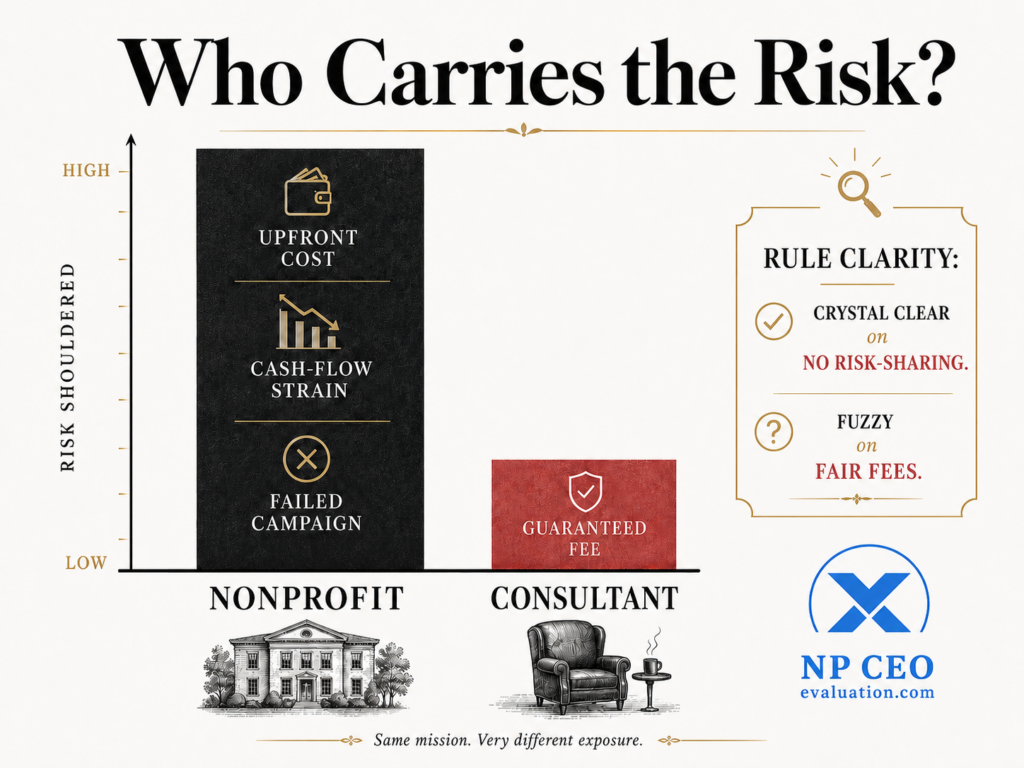
The fundraising profession is crystal clear about banning shared risk and comfortably vague about what professionals may charge.
Over the course of this series, I have tried to take the fundraising profession’s opposition to contingency compensation seriously. The prohibition has some merit. Percentage commissions can give a fundraiser a personal interest in the size of a charitable gift, produce fees bearing little relationship to the work performed and create the impression that the fundraiser owns part of the contribution.
Those are legitimate concerns. I remain convinced that paying a fundraiser ten percent of every dollar raised is usually a bad idea. Finder’s fees for introducing individual donors should also remain outside accepted professional practice.
I am no longer convinced that every payment influenced by success is ethically equivalent to a percentage commission. I am even less convinced that the profession should be allowed to settle the question simply by using the word “unethical.” This rule did not arrive on clay tablets. Many perfectly decent board members and nonprofit leaders are surprised to learn that suggesting a little skin in the game supposedly makes them unethical.
Some ethical principles are close to universal. Do not lie to donors. Do not steal charitable funds. Honor donor restrictions. Protect confidential information. The blanket rejection of success-related compensation is different. It is a policy adopted by a professional association governing the terms on which its members may be paid.
That’s all it is.
The Rule Is Broader Than It Sounds
The Association of Fundraising Professionals Code (link) tells members to reject finder’s fees, commissions and compensation based on a percentage of funds raised. That sounds like a prohibition on percentages, and the headline language is written that way. But, the accompanying guidelines go even further. They describe an acceptable consulting fee as one having no relationship to the outcome of the solicitation. In practice, that can prohibit a fixed success payment even when the amount is established in advance and does not change with the size of the grant or gift.
Consider two arrangements.
A consultant who receives ten percent of a $500,000 grant collects $50,000. The payment rises automatically with the size of the award, whether or not the larger award required more work.
Meanwhile, another consultant agrees to receive $2,000 for preparing an application and an additional $4,000 if it succeeds. The second payment is established before the work begins. It remains $4,000 whether the grant is $100,000 or $500,000.
Both arrangements are influenced by success, but they do not create the same incentives, conflicts or potential for excessive compensation. The first gives the consultant a claim on part of the contribution. The second divides a predetermined fee between an initial payment and a fixed payment based on the outcome.
AFP already recognizes that financial incentives are not automatically unethical. Its guidelines permit certain performance-based bonuses when they are established in advance and are not calculated as a percentage of contributions. The code does not eliminate incentives. It decides which incentives are acceptable. AFP permits some fundraisers to receive bonuses based on pre-established performance goals. For an outside consultant, however, it says an acceptable fee must have no relationship to the outcome of the solicitation. In other words, success may increase compensation in an approved bonus plan, but failure may not reduce the consultant’s guaranteed fee.
Is that really the ethical high ground the profession wants to claim?
The Rule Becomes Clear at a Convenient Moment
The fundraising profession is remarkably precise about one thing: the professional must not share the nonprofit’s financial risk. A grant writer may not reduce the initial cost in exchange for a fixed payment if the grant is awarded. A consultant may not agree to receive part of an established fee only if the work succeeds. The rule is categorical.
When the subject turns to how much the professional may charge, however, the moral clarity softens.
The code says compensation should be “fair and equitable”. According to whom? Is $250 an hour fair and equitable? Is $400? Is it fair and equitable to charge a flat $200,000 to manage a $1 million capital campaign? Perhaps any of those fees could be justified. The point is that the code leaves those questions to professional judgment while drawing a bright line against sharing risk.
On those questions, the profession offers judgment and flexibility. The AFP Code sets no maximum percentage of a campaign goal that may be consumed by consulting fees. There is certainly no rule declaring that a consultant who receives a full fee after a failed campaign has been unreasonably compensated. There is no formula for deciding when a nonprofit has paid far too much for far too little. I’ve been in this field long enough to know that some people charge breathtaking fees, but that’s just an opinion, not a clear violation.
Apparently, complexity requires discretion when the professional is collecting the money. It requires a bright-line ethical prohibition when the professional might have to risk some of it.
The AFP Code does not say it is unethical for a nonprofit to pay $50,000 for a feasibility study recommending a campaign the organization cannot complete. It does not say it is unethical for a grant writer to collect a full fee for applications producing no grants. It does not say it is unethical for a consultant to charge an amount that may be ordinary in the consulting market but enormous to the organization paying it.
Those situations are governed by professional judgment and the wonderfully accommodating word “equitable.”
But let a small nonprofit say, “We cannot afford the entire fee upfront. Would you accept less now and a fixed additional payment if this succeeds?” Suddenly the fog lifts. No. The professional may not share the risk. That is “UNETHICAL”.
That certainty falls hardest on small, emerging and street-level organizations. Large institutions can pay consultants from reserves, operating revenue or established development budgets. They can absorb the cost of an unsuccessful campaign or grant application. A neighborhood organization operating close to the edge may not be able to gamble $5,000 or $10,000 on an effort that produces nothing.
For that organization, risk-sharing may be the only way to obtain professional assistance. Yet the profession has declared that arrangement unethical while leaving the amount of the guaranteed fee comfortably fuzzy, perhaps even plush.
This does not prove that the rule was written in bad faith. It does mean that its precision serves the economic interests of the professionals subject to it. Consultants retain broad discretion to set their fees. Fundraisers are protected from uncertain payment. Nonprofits, including those with the least money and bargaining power, are told to pay regardless of the result.
The profession may argue that this arrangement protects donors and charitable missions. I can see some arguments to support that position. But the profession should not present the arrangement as an obvious and neutral moral truth. It isn’t. It is a business rule written by fundraising professionals, and it becomes admirably uncompromising at exactly the point where those professionals might be asked to put some of their own compensation at risk.
An Ethics Rule Is Not a Law, and It May Raise Antitrust Questions
When an inexperienced board member suggests hiring a grant writer on contingency, someone usually responds that the arrangement is unethical. That almost always ends the conversation. Unethical, however, does not mean it’s illegal.
AFP’s code is a professional membership standard. It applies to AFP members and people holding AFP-sponsored credentials. AFP can investigate violations and impose professional sanctions. The code is meaningful, but it is not a statute passed by Congress or a state legislature.
There is also an uncomfortable legal question running in the other direction. Can a professional association’s prohibition on a form of compensation restrain competition?
Federal antitrust laws apply to agreements that unreasonably restrain trade. The Federal Trade Commission recognizes that professional associations may adopt reasonable ethical codes, but warns that those rules can violate antitrust law when they unreasonably restrict the ways professionals compete, including competition over price or contract terms.
The Supreme Court has considered similar questions. In Goldfarb v. Virginia State Bar, (link) it held that a minimum-fee arrangement for lawyers violated antitrust law. In National Society of Professional Engineers v. United States, (link) an engineering association defended its prohibition on competitive bidding by arguing that price competition could lead to inferior work and threaten public safety. The Court did not dismiss those concerns, but it rejected the idea that calling a restriction ethical removed it from antitrust scrutiny. A professional association could regulate misconduct. It could not simply eliminate competition because its members believed competition might produce undesirable results.
AFP’s rule is not identical to either restriction. It does not establish a minimum fee or prohibit competitive bidding. AFP can also argue that its rule protects donors, public confidence and the integrity of charitable gifts. Its members do not control the entire market for fundraising services, though they are proud of their dominance in the field.
For those reasons, I am not claiming that the prohibition violates antitrust law. I have not found a reported decision directly addressing the specific question, and I doubt there is one. Yet.
But the concern is still legitimate. A professional association composed partly of competing service providers has told its members that they may not offer a particular contract term. Its guidelines also instruct members to discourage nonprofit clients from using it. Violations can lead to professional sanctions. The prohibited term happens to be one that could reduce a nonprofit’s initial cost and move some risk from the nonprofit to the professional.
That does not establish an antitrust violation. It does mean the profession should be more cautious about wielding the word “unethical” as though it were a trump card. A rule adopted by competing professionals to prohibit a form of competition deserves legal scrutiny, not moral immunity.
What a Better Rule Might Look Like
Personally, I would keep the prohibition on percentage compensation. A fundraiser should not receive a predetermined share of a charitable gift, and compensation should not increase merely because a donor or grantor gives more money. I have won huge grants without tremendous effort, and I have failed to win grants with applications I was truly proud of.
I would also retain the ban on finder’s fees for introducing individual donors. Fundraising depends on trust, relationships and organizational credibility. Treating access to a donor as a commodity creates risks that disclosure alone may not cure.
The strongest case for a limited exception involves institutional grant work. Foundations and government agencies generally use written criteria, formal applications and documented decision processes. A grant writer can improve an application but ordinarily cannot pressure a decision-maker in the way a commissioned solicitor might pressure an individual donor.
Under a revised rule, a consultant and nonprofit could agree to a fixed amount, established before the work begins, that would be payable in whole or in part if an application succeeds. The amount could not be calculated from the size of the award or increase when the funder awards more than expected.
The arrangement should have meaningful safeguards. Total compensation should be reasonable in relation to the work, expertise and risk involved. The agreement should be approved by an authorized officer of the nonprofit. The consultant should not receive or control the contributed funds. Payment should come from unrestricted resources unless the funder expressly permits the expense, and all funder disclosure requirements should be followed.
The consultant should also remain responsible for an honest assessment of the opportunity. A success payment should never justify exaggerating the likelihood of an award, pursuing grants that do not fit the mission or encouraging promises the organization cannot fulfill.
These protections would not eliminate every questionable arrangement. Neither does the current rule eliminate conflicts, excessive fees or poor professional judgment. Ethical standards rarely make misconduct impossible. Their purpose is to identify genuine dangers and establish reasonable boundaries.
Keep the Principle. Rewrite the Rule.
Bright-line rules are attractive because they are easy to explain and difficult to manipulate. Once exceptions are allowed, clever people will undoubtedly try to stretch them. That is a reason to draft an exception carefully. It is not a reason to pretend that a ten percent claim on every contribution is ethically indistinguishable from a fixed, capped payment allowing a nonprofit and consultant to share risk.
The fundraising profession has made a case against percentage commissions, though it too, might be worth examining. It has made a much less persuasive case for requiring nonprofit organizations to bear the entire financial risk of every unsuccessful fundraising effort.
Until the rule changes, AFP members should follow it. Professional standards cannot function if each member treats disagreement as permission to ignore them. Loyalty to a profession, however, should not require anyone to stop examining its rules. I’m not in the fundraising profession anymore, but I followed the rules when I was in the profession, and I would continue to do so until the rule gets changed.
Fundraisers should stop describing the broader prohibition as though it reflects a self-evident moral truth. The profession has chosen one business arrangement over another. It has chosen an arrangement in which the fundraiser is paid regardless of the result and the nonprofit bears the risk of failure. Once the rule is described honestly, it looks less like moral law and more like a professional preference dressed in armor.
A sound ethical standard should protect donors, nonprofits and charitable missions. It should not unnecessarily protect established business practices or place the heaviest burden on organizations with the fewest resources.The principle behind the prohibition deserves to survive. The rule deserves to be rewritten.