
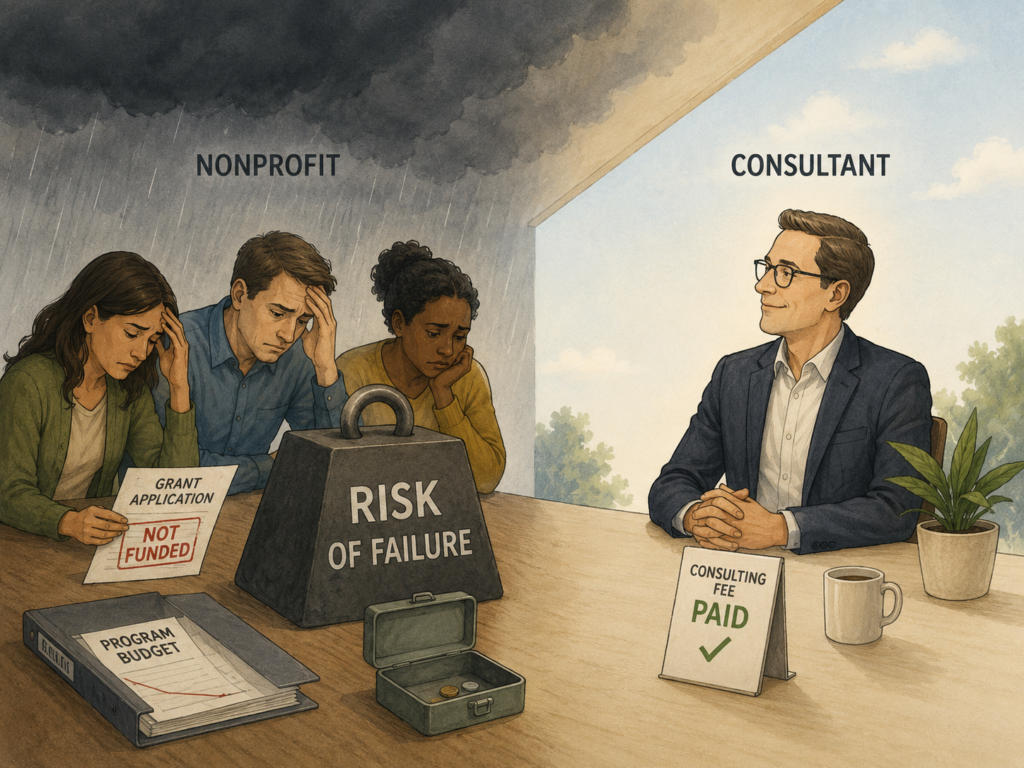
In the first installment of this series, I looked at the fundraising profession’s prohibition on contingency compensation. Most professional fundraisers know the rule: compensation should not be calculated as a percentage of the money raised, and payment should not depend on whether a particular gift or grant is secured. Board members are often surprised to learn that their good-faith suggestion that an organization find someone willing to work for a percentage is considered unethical.
Before questioning that position, I should make clear that I have always followed it. I also served on the board of my local chapter of the Association of Fundraising Professionals, so I understand the culture and reasoning behind the rule. I am not approaching this as someone who thinks fundraising ethics are unnecessary obstacles. I get it.
There are good reasons for the profession’s hard line. Charitable fundraising is not supposed to be a sales transaction, even though money changes hands and organizations measure the results. A donor or grantmaker might reasonably be disappointed to learn that part of a contribution was going directly to the person who secured it rather than to the organization’s work.
Percentage compensation also creates an obvious conflict. If a fundraiser receives ten percent of a gift, the fundraiser has a personal financial interest in increasing the size of that gift. This does not mean the fundraiser will behave badly, but ethical rules often try to avoid arrangements in which professional judgment and personal gain are placed in unnecessary tension.
The resulting fee may also bear little relationship to the work performed. A $500,000 grant application may not require ten times as much time or expertise as a $50,000 application, but a ten percent commission would produce a fee ten times as large. The percentage could be adjusted for the size and difficulty of the request, but the basic problem remains. The fundraiser begins to look less like a professional being paid for expertise and more like someone claiming a portion of the charitable funds.
There is also the question of who really raised the money. A grant writer may prepare an excellent proposal, but it rests on programs designed by other people, budgets prepared by other people and results achieved by other people. An individual gift may reflect years of relationship-building, the organization’s reputation, the CEO’s credibility or an introduction from a board member.
Fundraising success is usually a collective achievement. Paying one person a percentage can overstate that person’s contribution and make an organizational accomplishment look like an individual sale.
These concerns provide a strong argument against percentage compensation. They explain why professional fundraisers do not want to be treated as commissioned salespeople and why the profession resists arrangements that give a fundraiser a direct financial interest in the size of a contribution.
My discomfort begins when that reasonable principle is expanded into a broader conclusion. A prohibition against taking a percentage of charitable funds is not necessarily the same as a prohibition against every payment influenced by success.
A percentage commission, a predetermined fixed success payment and an ordinary performance bonus may all be described as contingent compensation. That common label does not establish that they create the same incentives or pose the same risks.
Suppose a consultant agrees to prepare a grant application for a modest initial fee, with an additional fixed payment if the grant is awarded. The total payment is established in advance and does not increase with the size of the grant. The consultant does not acquire a percentage interest in the award.
The arrangement still raises legitimate concerns. The consultant might encourage the organization to pursue an unsuitable grant, the compensation might be excessive for the work involved, or the organization might wrongly assume that the fee can be paid from grant funds. Those questions deserve attention, but they are not identical to the concerns created by a percentage commission.
The profession often responds that any payment dependent on success gives the fundraiser an unacceptable financial interest in the outcome. The difficulty is that every professional fundraiser has some interest in success. A staff fundraiser wants to keep a job, receive a raise and build a reputation. A consultant wants repeat business, referrals and a record of successful work.
We do not consider those incentives inherently unethical. We expect them to be managed through professional judgment, transparency, reasonable compensation and appropriate oversight. The mere existence of a financial interest should not end the analysis.
The better question is whether a particular arrangement creates an unreasonable risk that personal gain will interfere with the interests of the donor, the organization or the mission. Percentage compensation may fail that test because the fundraiser benefits directly from increasing the amount of the gift. A fixed success payment does not necessarily create the same incentive.
I have occasionally encountered discussions among grant professionals in which the argument begins and ends with, “I do not want to do the work and then not get paid.” That desire is entirely understandable. Professional grant writers are not volunteers, and they should not be expected to donate their labor simply because an organization has a worthwhile mission. Still, a professional’s desire to avoid financial risk is not, by itself, much of an ethical argument. A rule may benefit fundraising professionals and remain ethically sound, but that benefit should not be confused with the reason the rule exists. The ethical case should rest primarily on protecting donors, organizations and charitable purposes.
My doubts developed when I encountered nonprofits whose merit was not yet matched by their revenue. They were doing worthwhile work but could not afford to hire a competent grant writer and absorb the full cost of an unsuccessful proposal. That experience did not convince me that contingency compensation was automatically good, but it made the blanket answer feel incomplete.
The effect on those smaller nonprofits deserves its own discussion, and I will turn to it in the next installment. For now, the narrower point is that the profession has made a strong case against percentage compensation. I am less certain that it has made an equally strong case against every fixed, transparent and limited payment that depends partly on success.
Bright-line rules have value. They are easy to understand and harder to manipulate, and they prevent commissions from being disguised under more respectable names. Clarity, however, does not prove that every arrangement on the prohibited side of the line creates the same harm.
The fundraising profession is right to resist compensation that gives a fundraiser a percentage claim on a charitable gift. The harder question is whether that principle requires us to treat every form of shared financial risk as inherently unethical. I am not convinced that it does.