
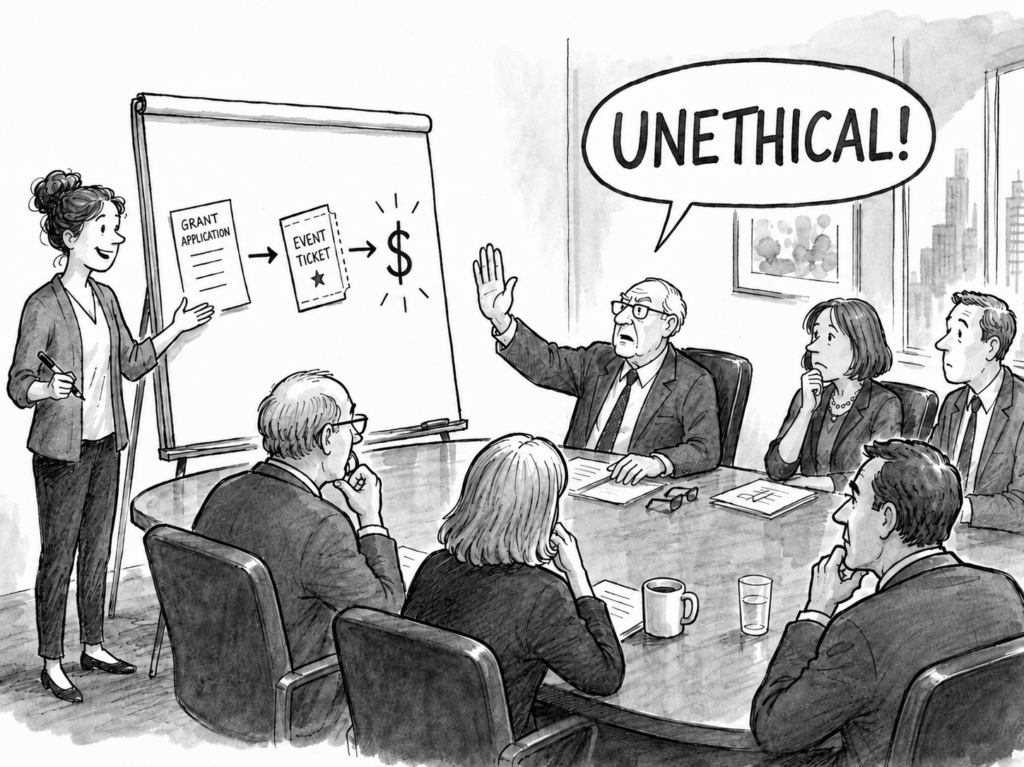
I have seen some version of this conversation take place multiple times. An enthusiastic new board member, or perhaps even an inexperienced nonprofit CEO, has an idea.
“We don’t really have the money to hire a grant writer right now. Why don’t we find someone who will write the grant and pay them out of the proceeds if we get it?”
Or perhaps the organization is considering a special event. Someone suggests hiring an event planner to run the whole thing and paying a reasonable percentage of whatever the profit is.
There is a certain logic to both suggestions. In fact, for a small organization without much cash, the arrangement can sound almost ideal. The organization gets professional help without taking money away from current programs, the fundraiser has a strong incentive to succeed, and everybody shares a little of the risk. Then somebody at the table says it.
“That’s unethical.”
And that almost always ends the discussion. Nobody wants to be the person who raises a hand and says, “Yes, but let’s go ahead and be unethical?” It really doesn’t seem that unethical to the uninitiated. In fact, it seems like a pretty good idea to someone new to the field.
The idea disappears from the agenda, the person who made the suggestion feels a bit embarrassed, and everyone moves on to the next item. Nobody ever asks the obvious question: Who says it is unethical, and exactly what is prohibited?
It turns out there is a pretty good answer.
The Association of Fundraising Professionals, generally known as AFP, says it. AFP is one of the principal professional associations for people who raise money for nonprofit organizations, and its Code of Ethical Standards is quite clear about percentage-based compensation. I served on my local chapter’s board, and it was an honor.
Under the AFP standards (link), fundraisers may receive bonuses or merit pay consistent with an organization’s normal compensation practices, but their compensation may not be based on a percentage of the funds raised. AFP also tells its members to decline finder’s fees, commissions and percentage-based compensation.
The Grant Professionals Association takes a similar position. Its ethical standards prohibit grant professionals from accepting a percentage of a grant award as compensation (link). In the education world, the Council for Advancement and Support of Education, generally known as CASE, also rejects commission-based compensation and compensation based on a percentage of funds raised (link).
These are not obscure organizations with a three-person ethics committee meeting in the back booth of a Denny’s. They are respected professional associations, and their standards have had enormous influence on accepted fundraising practice. AFP also has a formal process for investigating alleged ethical violations and sanctioning members.
So when an experienced development professional says that percentage-based fundraising compensation violates the ethical standards of the profession, that person has very solid ground beneath their feet.
Still, perhaps because I used to be a lawyer, I see a little wiggle room. I think it helps to be precise.
A professional association’s code of ethics a law. It is not the same thing as a statute passed by Congress or a state legislature. AFP’s code directly governs AFP members. The Grant Professionals Association’s code governs its members. Those standards have helped establish professional norms far beyond their actual membership, but the source of the rule matters.
And it also helps to pay attention to the exact wording. Paying a fundraiser 10 percent of every dollar raised clearly violates the AFP standard. Paying someone a finder’s fee for identifying a major donor is also prohibited. Paying a grant writer 5 percent of a successful grant runs squarely into the Grant Professionals Association’s ethical rules. Clear cases – no doubt.
Other arrangements require a little more thought, though. A development director who receives a normal year-end performance bonus may be perfectly acceptable under the AFP code, even if fundraising success was one factor in assessing that employee’s performance. AFP expressly allows bonuses and merit pay, provided they are consistent with the organization’s compensation practices and are not calculated as a percentage of funds raised.
What about paying an event consultant a flat $5,000 bonus if a new event reaches a $100,000 goal? That is not a percentage of the money raised, but the broader ethical concern about tying compensation directly to fundraising outcomes is still in play. Already, the simple statement that “contingency fundraising is unethical” requires a few paragraphs of explanation. What if my employer gives me a $1,000 bonus for every $100,000 I bring in? What if we never talk about percentages, but my bonus goes up in good years and down in bad years?
That does not mean the ethical rule is wrong, or inapplicable. It does mean we ought to make sure we understand a rule before invoking it to end a board discussion.
Over the next few posts, I want to look more closely at contingency fundraising: why the fundraising profession adopted such a strong prohibition, whether the underlying ethical concerns apply equally in every situation, what the rules actually say, and whether the current rule creates particular problems for small and underfunded nonprofits.
I have spent a lot of my career around nonprofit organizations, and I have learned to become a little suspicious whenever a complicated conversation is ended by a single word.
“Unethical” is a very powerful word. I want to make sure we are using it correctly.