
Nonprofit boards rely heavily on staff support, and for good reason. Trustees are volunteers with limited time, while employees are familiar with the organization and often have the skills to accomplish in an hour what might take a board committee an afternoon. When the CEO offers to have staff help out, it is usually sensible and economical to say “yes”.

That said, there are a few situations where accepting that help may create problems. Two involve important board responsibilities: evaluating the CEO’s performance and determining the CEO’s compensation.
In both situations, the board may inadvertently put employees in an uncomfortable position. Even when the CEO offers assistance with the best intentions, the board might be wise to decline.
“Could You Pull Some Salary Information for Us?”
Suppose a nonprofit board is reviewing its CEO’s compensation. The compensation committee wants to know what chief executives at comparable organizations are earning. Someone suggests asking the CEO to have the CFO or HR director gather the information.
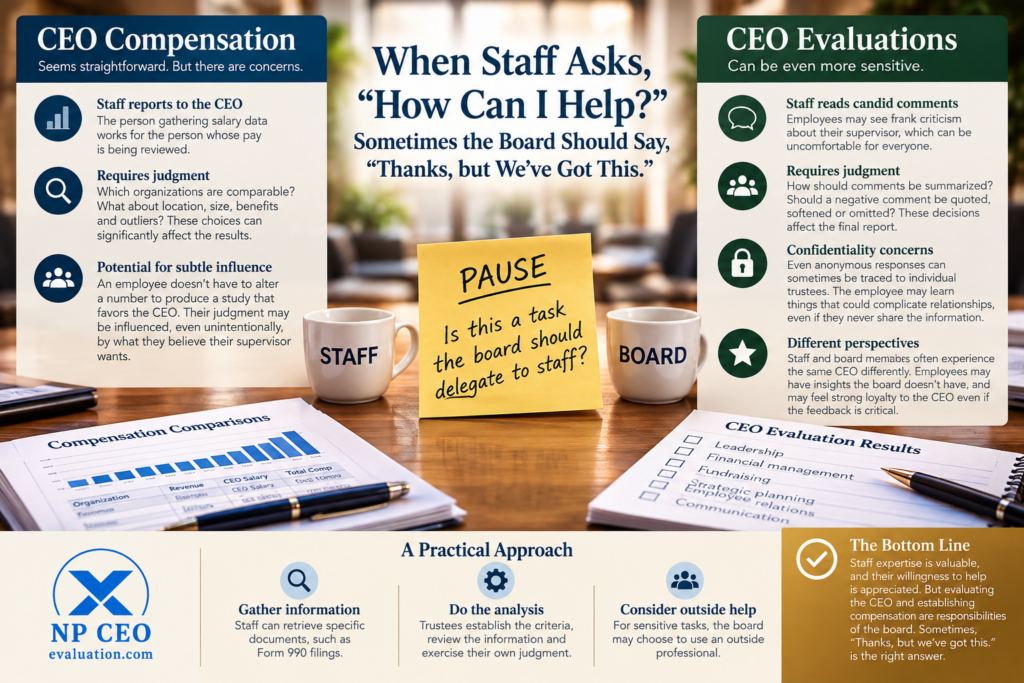
It’s a reasonable suggestion. The employee knows how to navigate IRS Form 990 filings and can produce a spreadsheet faster than several volunteer trustees. But it’s important to remember that the employee gathering the information reports to the person whose salary is being reviewed.
That doesn’t necessarily create a problem. The employee may be completely objective, and the CEO may have no interest in influencing the process. But the board doesn’t know what pressures the employee may be experiencing. Perhaps the CEO has mentioned feeling underpaid. Perhaps the employee knows that the CEO expects a substantial raise. Or the CEO might innocently suggest several organizations as appropriate comparisons, perhaps unconsciously favoring those that happen to pay their executives particularly well.
It’s important to remember that gathering compensation information involves more judgment than simply copying numbers into a spreadsheet. Which organizations should be included? Should a nonprofit with twice the revenue be considered comparable? What about an organization in a much more expensive city? Should the comparison include salary alone or also retirement contributions and other benefits?
These decisions can significantly influence the results. An employee doesn’t have to falsify a number to produce a compensation study that favors the CEO. Selecting certain organizations, excluding others or presenting the information in a particular way can change the apparent market rate. It’s subtle, and the employee may not even realize that their judgment is being influenced by what they believe their supervisor wants.
“Could You Tabulate Our CEO Evaluations?”
Now suppose the board is conducting its annual evaluation of the CEO. Trustees have completed questionnaires rating the CEO’s performance in leadership, financial management, fundraising and other areas. Someone needs to collect the responses, calculate the scores and summarize the comments.
Asking a capable staff member seems reasonable. This is dull work, compiling numbers and calculating percentages. (I know!) But the truth is that this assignment may be even more sensitive than gathering compensation information.
Imagine being asked to compile comments such as “The CEO doesn’t delegate effectively,” “I’m concerned about employee morale,” or “The board doesn’t always receive complete information.”
Now imagine knowing that the person being criticized will conduct your next performance review and determine your salary increase. Or, more positively, imagine that you have seen the CEO work day and night, and you feel like the criticism is unfair.
Simply calculating numerical scores requires relatively little discretion. Deciding which comments to highlight and how to characterize them is another matter, and it requires judgment. If three trustees express concerns about the CEO’s treatment of employees and seven don’t mention the subject, should the report emphasize the concerns or the absence of broader criticism? If a trustee submits an especially harsh comment, should it be quoted, softened or omitted? Even if the directions are to compile and report all commentary verbatim, without editing, the staff member is put into an awkward situation handling such material.
Confidentiality is a big problem. Trustees may not realize their individual responses will be reviewed by someone who works closely with the CEO. Even anonymous comments can sometimes be attributed to particular trustees. The staff member may learn things about the board’s opinions of the CEO that neither the board nor the CEO intended the employee to know. That knowledge could complicate relationships even if the employee never shares a word of it. The CEO may feel a bit compromised if one of their staff members is aware of rumblings on the board. All this, to save a little time or money? Is it worth it?
The issue isn’t whether staff members can be trusted. It’s whether the board should put employees in this position. Unlike the salary study, where the principal concern is how the employee’s judgment might influence the results, even perfectly accurate tabulation of an evaluation can expose employees to information they’d probably rather not have.
The Pressure the Board Doesn’t See
One difficulty of nonprofit governance is that board members and employees may experience the same CEO differently. A trustee may interact with the CEO at monthly meetings and occasional organizational events. The CEO may be invariably professional, welcoming and responsive. Employees experience the CEO as a supervisor every day. They know how the CEO handles disagreements, responds to criticism and reacts when things go wrong.
Even in well-managed organizations, employees understand that their supervisors have considerable influence over their professional lives. Meanwhile, even attentive boards may know considerably less about an organization’s internal culture than they think they do. The employee compiling the evaluation may have a very different understanding of the CEO than the trustees whose opinions are being collected.
Don’t Forget the Difference Between Governance and Management
There’s another consideration. Even when a board has a legitimate reason to request staff assistance, it should ordinarily coordinate that request with the CEO. The board supervises the CEO, and the CEO supervises the staff. Individual trustees and board committees generally shouldn’t assign work directly to employees or interfere with their ordinary responsibilities.
If a compensation committee wants the CFO to retrieve several Form 990 filings, it should ordinarily discuss the request with the CEO. The CEO needs to know how employees’ time is being used and what demands are being placed on them.
But keeping the CEO informed is different from allowing the CEO to direct the board’s evaluation or compensation decisions. The CEO can help coordinate appropriate administrative assistance and offer useful information about the organization and potential comparisons. But the board should retain control over which comparisons are used, how evaluation responses are interpreted and what information trustees receive.
If an assignment is so sensitive that involving the CEO would compromise the independence of the process, that may be a good reason for the board to handle the work itself or obtain outside assistance.
Sometimes, “Thanks, but We’ve Got This” Is the Right Answer
None of this means nonprofit boards must hire outside professionals whenever they evaluate a CEO or review executive compensation. I’ve even provided a guide to conducting a salary review without staff or outside assistance.
A compensation committee might establish criteria for selecting comparable organizations, ask staff to retrieve specified Form 990 filings, and then review the information and prepare its own analysis. A board could use an online survey tool to collect CEO evaluation responses and assign one or two trustees to compile the results.
The important distinction is between gathering information and exercising judgment about what that information means. Before delegating work involving CEO performance or compensation, trustees should consider whether the assignment requires independent judgment, whether the employee might believe the CEO has a preferred outcome, and whether the work could complicate the employee’s relationship with their supervisor.
Nonprofit boards should appreciate the willingness of staff to help fulfill their responsibilities. Good relationships between trustees and employees are valuable, and staff expertise often makes board service more effective. But evaluating the CEO and establishing the CEO’s compensation are responsibilities of the board. Trustees should think carefully about how the information supporting those decisions is gathered, interpreted and presented.
Sometimes that means assigning the work to a committee. Sometimes it means using an outside professional. And sometimes it means having a couple of trustees spend an afternoon doing something a staff member could accomplish in half the time.
That may be less efficient, but protecting employees from unnecessary conflicts and ensuring the integrity of the board’s decisions are worth the inconvenience.
The next time a helpful staff member asks, “What can I do to help?” the board should be grateful. And sometimes, it should respond, “Thanks, but we’ve got this.”