
I have been on a road trip from Kansas City to Buffalo to Fairhope, Alabama and home again. All that windshield time has given me time to ponder some of the bigger challenges that are going to affect the nonprofit sector. My business focuses on CEO evaluations and salary surveys, but stepping away from the desk gives me time to think more broadly about nonprofit leadership, governance, and management.
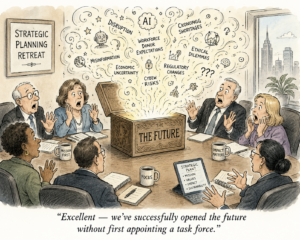
One of the game-changers facing the entire economic world is Artificial Intelligence. Right now, most organizations are using the capabilities of AI to produce newsletters and produce minutes of meetings, but the impact of AI is likely to be massive and, for me, at least, unpredictable.
What is much harder to say is exactly how it will change things, how quickly those changes will arrive, and which organizations will be most affected. That creates a real challenge for nonprofit boards and executives who are trying to create strategic plans.
Strategic planning is already difficult enough when the future is merely uncertain. It becomes even harder when a disruptive technology is likely to change the way people work, communicate, learn, organize, donate, seek services, and make decisions, but nobody can say with confidence exactly what those changes will look like.
I feel confident in predicting that AI is going to affect nonprofit operations. It may reduce the time required for many administrative tasks. It may help staff draft documents, summarize meetings, analyze information, prepare grant materials, communicate with donors, translate content, and manage routine work more efficiently. Used carefully, it may enhance the capacity of individual staff members and allow small organizations to do some things that once required larger teams or outside consultants.
That is the optimistic side, and it should not be dismissed.
But there is another side. AI may also disrupt employment, change client needs, alter donor expectations, increase misinformation, expose confidential information, and create new risks around accuracy, bias, privacy, and trust. Some communities may benefit quickly from these tools. Others may be harmed by them or left behind by them. Nonprofits cannot assume that technological change will be evenly distributed or automatically humane.
So how does a board create a strategic plan in that kind of environment? I think we will need to plan with humility and flexibility.
A strategic plan for a time of disruption needs to be a compass instead of a crystal ball.It should help the organization make better decisions even when the road ahead is changing. Just as in calmer times, It should clarify mission, values, priorities, risks, capacity, and the kinds of choices the organization is prepared to make.
That means AI should be part of the strategic planning conversation, but not necessarily because every nonprofit needs a separate AI strategy. The better question is broader: how might AI affect our mission, our people, our operations, and the community we serve?
For some organizations, the answer may involve internal efficiency. For others, it may involve client access, workforce training, communications, fundraising, advocacy, or data privacy. For still others, the most important question may be whether AI-driven economic disruption will significantly change demand for the organization’s services.
That is why strategic planning in this moment should include scenario thinking. What happens if AI mostly helps us work more efficiently? What happens if it changes the needs of the people we serve? What happens if funders expect faster reporting and more data? What happens if our staff members begin using AI tools before we have policies in place? What happens if our clients are harmed by misinformation, automation, job loss, or reduced access to human help?
A good strategic plan does not need perfect answers to those questions. The answers for an art museum are going to be different than they will be for a job training program. But a good strategic plan should make sure the organization is asking them.
This also argues against overly rigid long-term plans. A three-year plan may still be useful because it is close enough to guide budgets, staffing, programs, and accountability. A five-year horizon may help with capacity, facilities, technology, succession, and major funding questions. Longer horizons may be helpful for vision and scenario planning, but the further out the organization looks, the more humble the plan should become.
The presence of potential AI changes doesn’t mean we should throw up our hands and say, “I don’t know what’s coming!” It does not make strategic planning obsolete. It makes flexibility more important.
Nonprofits still need to know who they serve, what they stand for, what they are trying to accomplish, what capacity they need, and what risks they must manage. But they also need plans that can be revisited, tested, and adjusted as reality changes.
In a time of disruption, the best strategic plans will not be the ones that somehow guessed the impacts of everything correctly. As always, they will be the ones that helped organizations stay clear, attentive, adaptable, and faithful to their mission while the world around them changed.
Great content! Keep up the good work!