
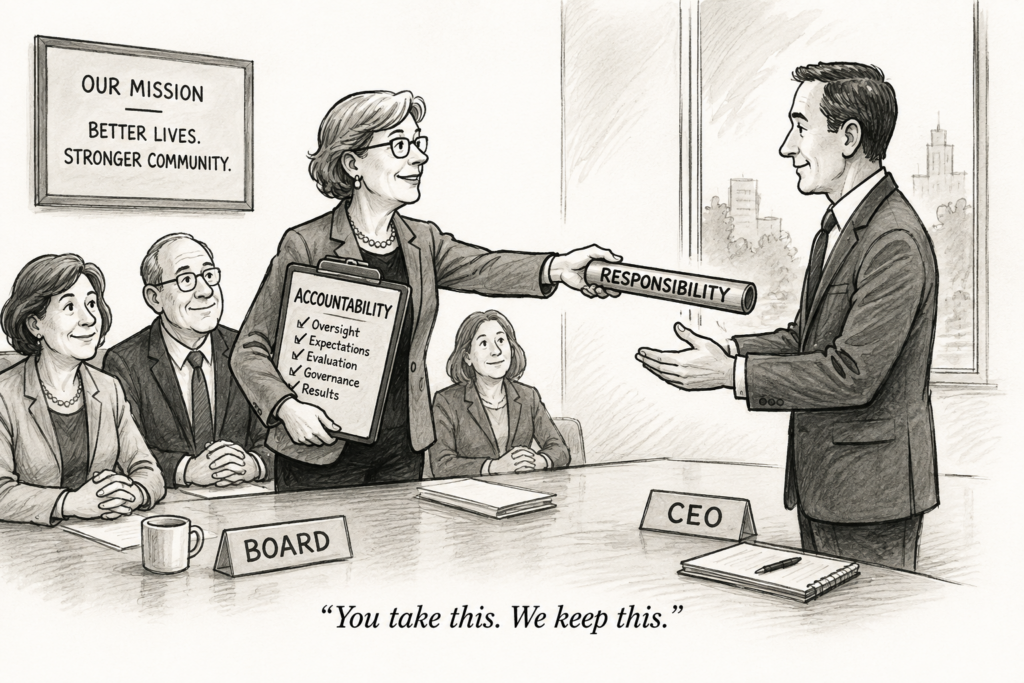
I have developed a mild aversion to the word accountability. Part of my aversion is its wildly overuse in business and politics. I normally prefer responsibility. We take responsibility. We are held accountable. One sounds like something a capable person accepts. The other sounds like something imposed after something has gone wrong.
For nonprofit boards, though, the distinction between the two words can actually be useful, and it can help nonprofit boards remember their role. The CEO is responsible for running the organization. The board is accountable for making sure it is being governed well.
A board hires a chief executive when an organization grows to the point that a group of volunteers cannot effectively manage it. Your grandchild’s little league baseball team doesn’t need a CEO. The local league probably doesn’t have a CEO. The national organization does have a paid CEO, who takes responsibility for staff, programs, finances, fundraising, implementation of strategy and the countless decisions involved in running the organization every day.

The volunteer board should not try to do those things. Its job is to establish expectations, approve strategy, provide financial oversight and evaluate the CEO’s performance. They set the CEO’s compensation, hire and fire the CEO, determine the goals, and delegate responsibility for managing the organization.
Here’s the key: they delegate the responsibility, but not the accountability. If nobody hires umpires to show up at the Little League World Series, the CEO is responsible, but the board remains accountable for not making sure the CEO was on top of things. If an organization winds up in hot water, the board cannot simply say, “That was the CEO’s responsibility.” It still needs to ask whether it hired the right person, established clear expectations, recognized problems and acted when action was needed.
That is where accountability belongs.
The accountability/responsibility distinction also helps keep boards from micromanaging. A board can remain accountable without becoming responsible for operations. It can approve the budget without managing every expense, approve strategy without directing staff and evaluate the CEO without supervising the CEO’s employees.
There is one more important piece. Boards should be careful about talking about “holding the CEO accountable” when they have never clearly established what the CEO was responsible for accomplishing. Clarity of expectations needs to come before accountability.
The annual evaluation should not be the first time a CEO learns what the board considers important. Sometimes there are multiple goals in conflict, especially when resources are limited. Should the Little League CEO set out to expand the number of players or generate an elite level of play? Seek sponsorships for professional umpires or rely on volunteers? Expectations should be discussed in advance, and the evaluation should then look at how effectively the CEO fulfilled those responsibilities.
I still prefer the language of responsibility. It feels more constructive and less punitive. But nonprofit governance needs both ideas.
The CEO can take responsibility for running the organization. The board can delegate that responsibility. What it cannot delegate is accountability for whether the organization is being governed well.