
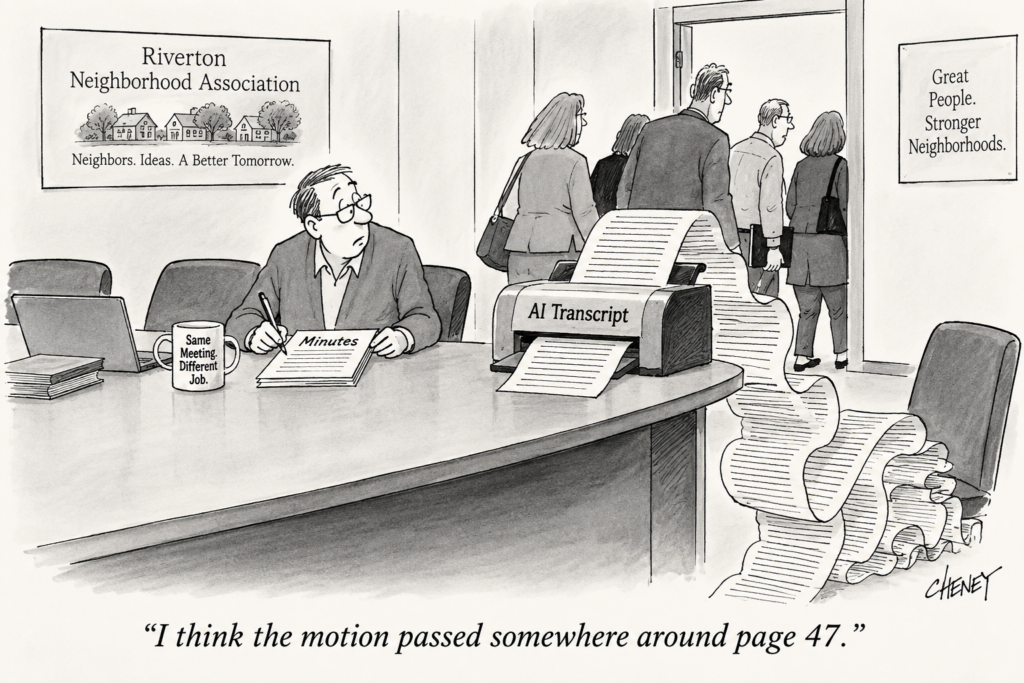
On Tuesday evening, I was elected secretary of an organization I joined earlier this year. My rapid ascent to the board is attributable to my willingness to volunteer, not to anyone’s judgment of my merit, . I am not sure who everybody is and suddenly I’m responsible for recording what they said.
I’ve served on a fair number of boards over the years, and I’ve seen wildly different approaches to minutes. Some organizations produce a couple of paragraphs recording the decisions that were made. Others produce something approaching a transcript, including who said what, who disagreed with whom, and, if you read between the lines, who the secretary likes.
I was planning to use this space today to talk about the RIGHT way to prepare minutes. I actually think it’s becoming a more important subject because so many meetings can now be recorded and transcribed automatically. AI can produce ten pages of moderately accurate notes from a one-hour meeting with almost no effort.
Once again, AI is stepping in to make things easier while also making them worse. A transcript is absolutely not the same thing as minutes. Minutes aren’t supposed to preserve everything everybody said. They’re supposed to create a useful record of what the organization did. Who was there? Was there a quorum? What did the board decide? What motions were made and what happened to them? Who agreed to do what afterward?
That distinction matters because board minutes are not simply notes for people who missed the meeting. They’re part of the organization’s official record, and they should be treated as official documents. I was prepared to an explanation of how to prepare proper minutes.
My plan to write a that article got shot down by the people at Ideals Board. A few weeks ago, they published this excellent guide that I ran across while preparing to write this post. Their advice is that minutes should focus on outcomes rather than discussion and should clearly record attendance, quorum, motions, votes, decisions and action items. They also make the point that minutes are not a transcript and should use concise, neutral language rather than recording individual opinions or reactions.
Their article is good enough that writing my own seemed pointless. The link above even leads you to a template you can download, and it is a good one.
Now, even if you aren’t your board’s secretary, there are good reasons to make sure you understand what proper meeting minutes are.
For nonprofits that file Form 990, the IRS actually asks whether the organization contemporaneously documented the meetings and written actions of its governing body and committees authorized to act for it. The IRS defines “contemporaneously” as no later than the next meeting or 60 days after the action, whichever is later.
State laws also apply. Here in Missouri, nonprofit corporations are required to keep permanent records of board and member meetings, along with actions taken without a meeting and actions taken by authorized board committees. I’m not practicing law anymore, but I can give you the free advice that ignoring statutes isn’t wise.
Minutes can also matter a great deal when a board establishes CEO compensation. One of the requirements for obtaining the IRS’s rebuttable presumption that compensation is reasonable is adequate, timely documentation of the decision. That documentation should include what compensation was approved, who was present for the debate and vote, the comparability data the board relied upon, any conflicts of interest and the basis for the decision. That’s the kind of thing you don’t want to reconstruct three years later from somebody’s memory.
My worry about AI transcription is that it may tempt boards to opt for all-inc
lusiveness instead of focusing on the actual actions of the board. If a computer can effortlessly record everything everybody says, why not keep all of it? After all, a complete record will include the raisins with the bran, right?
Suppose a board spends 20 minutes debating whether to replace the roof. During the discussion, one member says the contractor seems unreliable. Another says the treasurer is being overly cautious. Someone else makes a joke about the previous board. Eventually the board votes 7-1 to accept the bid.
Twenty years ago, the secretary probably wrote something like: “Following discussion, the board voted 7-1 to accept ABC Roofing’s proposal for $82,500.”
 That is exactly what future board members need to know, without all the folderol. The AI transcript, meanwhile, may preserve every speculation, poorly phrased comment, joke and irrelevant tangent uttered along the way. in the mass of verbiage. It’s possible that transcription will improve over time, but most transcripts are full of mistakes, ranging from how to spell Micaela to there/their/they’reinterchangeable homonyms.
Good minutes require judgment. Somebody has to distinguish between what was said and what actually made a difference. Which means that, approximately 48 hours into my tenure as secretary of a neighborhood association, I have already developed a philosophy of minutes. When they are available, I will look at transcripts to confirm my notes, but I won’t clog the pages with irrelevant detail.