
I have a Google Alert set up to let me know when nonprofit compensation or nonprofit CEO evaluations appear in the news. For the past few weeks, my alert has been crowded with stories about a Southern California nonprofit CEO who was payed $1.6 million over 2 years, while residing in Hawaii. At first glance, it sounds outrageous, but if you read a bit deeper, it gets a bit blurrier. I’ve been wanting to write about it here, but there were so many angles and “what ifs” that I didn’t get around to putting something together yet.
I count myself lucky for coming across a LinkedIn post on the topic by Joshua Hueth this week about the situation, and I thought it was excellent. He did an outstanding job of separating the light from the heat, without relitigating the age-old question of what compensation level justifies a media freak-out. Instead, he focused on what really went wrong.
It is true that CEO compensation really is unreasonable in some cases. Occasionally, of course, nonprofit insiders really do use charitable assets for their own benefit, and those cases deserve all the hooting and hollering the IRS and the media can muster. Sometimes the board has been too cozy with the CEO, has failed to look at comparable organizations, or has simply allowed compensation to creep upward without asking enough questions.
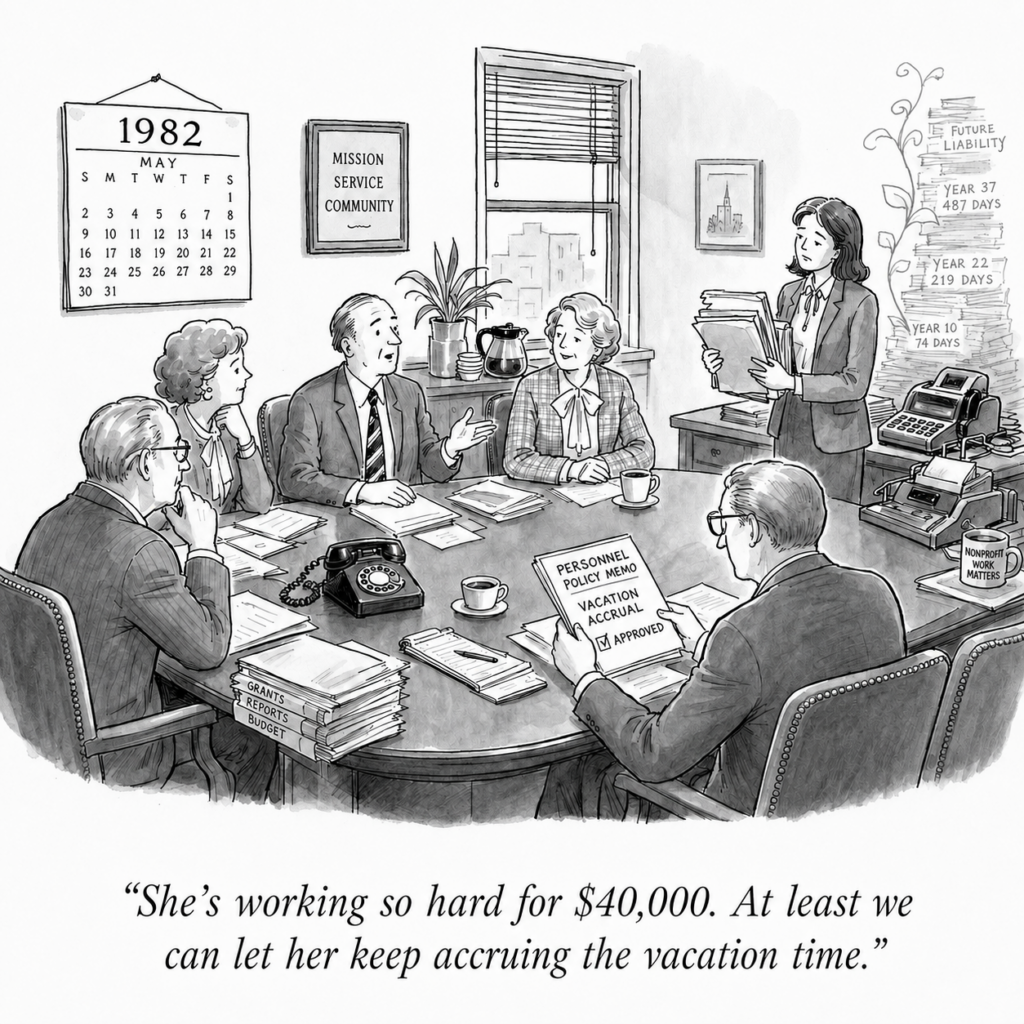
All that said, the size of the number, by itself, does not tell us very much. In this case, the “staggering” $1.6 million represented 2 years of salary and included a 40-year accrual of vacation. The CEO was certainly paid well, but I know of small business owners in charge of much simpler operations making a great deal more.
What I appreciated about Mr. Hueth’s post was his emphasis on process. The important question is not whether a salary seems high to me, or to a reporter, or to someone commenting on LinkedIn. The important question is whether the board can explain how it reached its decision.
That sounds less exciting, but it is a much better way to think about nonprofit compensation. Boards have a responsibility to determine reasonable compensation. That means looking at organizations that are actually comparable, understanding the scope and complexity of the CEO’s job, considering the full compensation package, and documenting the basis for the decision. It also means making sure the people approving the compensation are independent and do not have a financial interest in the outcome. That’s how it should work.
Frankly, “Holy cow, if you look add up the salary paid over multiple years and add in accrued benefits, it adds up to a big number!” seems more like “gotcha” than a compensation analysis.

One part of Hueth’s post particularly caught my attention. A significant portion of the compensation issue in this case had grown out of accumulated vacation time. That is not nearly as dramatic as a board suddenly voting to hand a CEO a huge bonus, but it may be a more useful governance lesson.
Policies have consequences over time, and those consequences can be hard to notice. A board can adopt or tolerate a policy that seems harmless in year one and discover forty years later that it has created a very expensive obligation. Nobody necessarily made one terrible decision to throw millions of dollars at the CEO. The problem may have been that nobody went back and reconsidered an old decision as circumstances changed. Forty years of perfectly ordinary decisions, or non-decisions, eventually produced a spectacular number.
I see this kind of thing often in nonprofit governance. Boards (and the media) spend a lot of time worrying about eye-catching failures, conflicts, scandals, bad actors, or the possibility that someone will do something obviously irresponsible. Those things deserve attention, but many governance problems are much less theatrical. They grow quietly because a policy was never revisited, a compensation practice became customary, or everyone assumed that somebody else had already checked.
That is why I liked Hueth’s piece so much. He did not simply point at a large number and announce that it was outrageous. He looked at the governance behind the number. His quick summation of IRS Section 4958 is the best I’ve ever read:
Under section 4958, compensation is presumed reasonable if three things happened before the money moved. An authorized body with no conflict of interest approved it in advance, that body obtained and relied on appropriate comparability data, and it documented the basis for the decision at the time instead of reconstructing it afterward. Meet all three and the burden shifts to the IRS to prove the pay was unreasonable. Miss any of them and you’re defending a number with nothing but your own confidence in it.
One technical caveat: failing to meet all three requirements does not make the compensation unreasonable; it simply means the organization does not get the benefit of the rebuttable presumption. At least so far, though, this is not an IRS enforcement story. It is a governance and public-image story. It is in the news because a reporter accessed publicly available information, pulled out a calculator and came up with a big number. I think the organization did the right thing by responding and explaining the effect of the accrued vacation.
For board members reading this, it is important to be thoughtful about compensation and public image. The goal is NOT to pay CEOs as little as possible – good CEOs deserve to be well-compensated. Unreasonable compensation can create legal problems, while even reasonable compensation can create a public-image problem if the board can’t explain it. The goal is to make a thoughtful, defensible decision based on relevant information and then be able to explain that decision if somebody asks. The lesson for boards isn’t “don’t let your CEO accumulate forty years of vacation.” That’s awfully specific. The lesson is to occasionally look at the things nobody is worried about. Ask what liabilities are quietly accumulating. Ask what an old policy looks like at today’s salary. Ask whether a compensation practice that made sense ten or twenty years ago still makes sense now. Good governance isn’t only about making good decisions. Sometimes it’s about remembering to look again at the decisions somebody who sat in your seat years ago already made.